
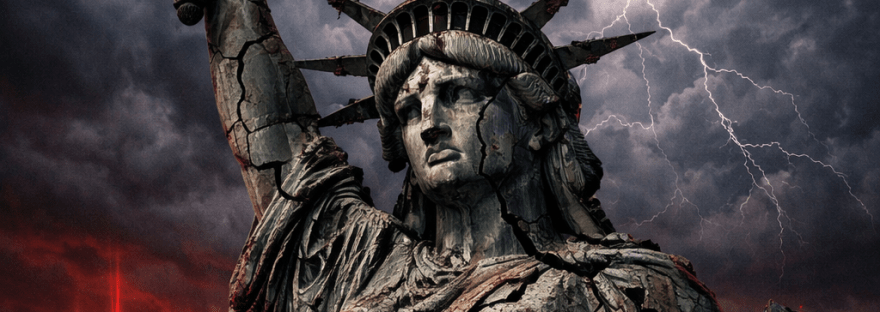
Dystopias aren’t frightening because they’re imaginative—they’re frightening because they feel familiar. Watching The Handmaid’s Tale, I kept thinking: the scariest part isn’t how Gilead begins. It’s how quickly people learn to live with it.
Why Gilead Feels Plausible
I’ve finally stepped into the world of Gilead in The Handmaid’s Tale. I’m currently watching it on Hulu—season 3—and I put it off for so long. As a writer, I should probably be reading the book, because in most cases television and film don’t do the source material justice. But this series seems to closely follow the novel, and I’m hooked. Honestly, I was hesitant at first because it didn’t seem interesting—until I started reading more about it and seeing the reviews. This is pure dystopia, right up my alley, and it feels incredibly realistic and plausible. In some ways, it even mimics what is happening in America today. Once again, men are (for the most part) taking control—but don’t get me wrong: women are just as much a part of that control, especially Serena Joy, the Commander’s wife. I also find it interesting that Serena was once a singer on Christian television and later advocated for women staying at home. Hmmm… where have I seen this before? Oh right—Erika Kirk, who often advocated for women having lots of babies and staying at home, putting one’s career aside for marriage. Don’t get me wrong: I’m all for women, equality, work, and families—but ultimately, people should live their lives the way they see fit. As a father of a daughter, I would never wish to dictate what I want my child’s life to look like based on misguided belief systems.
The Slow Boil: Digital Control in Plain Sight
In The Handmaid’s Tale, it’s shocking how simple it was to overtake a nation, create a new society, and seize so much control over women and their bodies. In America, it reminds me of the analogy of a frog sitting in boiling water—how we slowly get used to our rights being removed. Some may feel I’m being overdramatic because we can still walk around, go to work, go to school, shop, and live our lives without obvious disruption. But behind the scenes, we’re being controlled—digitally, of course.
Billions of people leave their digital footprints online, and that information is sold every day. One day it will haunt us, used against us, because many people believe their indiscretions are hidden. They aren’t. Profiles set to “private” are not truly private. This information will be used against us one day—like a modern-day Oceania from Orwell’s 1984. We’re practically already there, with Google and big tech using our information for profit, and you and I don’t see a dime. (I’m not on social media, but I still have a digital footprint through my blogs—and if they were found, they could certainly be used to label me a dissenter.)
And it isn’t abstract—especially in the U.S. In 2024, the FTC went after the location-data broker X-Mode Social (and its successor, Outlogic) for selling sensitive location data—the kind that can expose visits to reproductive health clinics, places of worship, and shelters. The market is real, and it’s lucrative. Pair that with real-time ad tracking and you get a map of “private” life. And it’s not just marketing: police have used facial-recognition tools with documented misidentifications, including the wrongful arrest of Robert Williams in Detroit after a false match. None of this requires a jackboot on your porch—just enough convenience, enough fear, and enough people willing to trade privacy for comfort.
When Control Turns Physical
In The Handmaid’s Tale, women are rounded up like cattle and indoctrinated into their new lives. It’s plausible—especially if force is used and normalized, like in Gilead, where women have an eye plucked out, are tased into compliance, and are turned into servants. And the world just stands by and watches. In the show, the world knows about Gilead, yet it does nothing to stop it—except, in a small way, Canada, which offers refuge.
How Democracies Backslide
For instance, in The Handmaid’s Tale, Congress is killed by the Sons of Jacob in what’s known as the President’s Day Massacre—targeting the highest echelons of the U.S. government and resulting in the deaths of the (unnamed) U.S. President and most of Congress. Is that all it would take to seize control? It’s a frightening thought. Even those in power aren’t protected—at least not in this scenario. Many would argue this is fiction and could never happen, but I think we almost saw an echo of it in the insurrection of January 6, 2021—the Capitol attack. If that had succeeded, and if members of Congress had somehow been eliminated, it would have reshaped the country. That’s why it’s so frightening: we came closer to our own dystopia and dictatorship than many want to admit.
In America, power rarely shifts in one cinematic moment. It concentrates through “temporary” measures that don’t fully roll back. After 9/11, the USA PATRIOT Act expanded surveillance fast—sold as urgent and patriotic. Then in 2013, Edward Snowden’s leaks exposed the NSA’s bulk phone-records (telephony metadata) program tied to Section 215—proof of how extraordinary authorities can become normal. The same dynamic shows up in elections: after Shelby County v. Holder (2013) effectively ended Voting Rights Act preclearance, states had more room to rewrite rules. Texas moved to implement a strict voter ID law almost immediately. The details vary, but the pattern doesn’t: guardrails loosen, and the pitch is always “security,” “integrity,” and “order.”
The Temptation of “Order”
It’s a terrifying thought how close American society can come to submission under government control. Even now, as we speak, the increase of federal officers—what I consider modern-day Gestapos—feels like a warning sign that expanded control could be taken. Living in California, I believe there would be resistance, but many states could be forced to comply, and others would comply willingly—accepting a “new order” in the name of stability and “the good of society.”
The belief is always the same: if men and women (especially women) are controlled—especially their bodies—we can go back to “simpler times,” where women return to the kitchen, raise families, remain silent, and be a good wife, like the version of the 1950s people like to romanticize. I was born in ’79 and don’t know that time, but sure, it had the charm of simplicity. If you watch Back to the Future, it looks like a time of innocence. But we’re no longer in those times—and we can’t go back. Not that I would want to.
What I Believe (and Why It Matters)
People have a right to live—regardless of how I feel about how they should live. It’s their life. There will always be men and women trying to control us, but not everyone is controlled the same way. The wealthy and the elite often get a free pass. It’s the rest who are easier to manage—the masses—and it isn’t as hard as many people think.
When Financial Access Becomes a Weapon
I’m reminded of a scene (early in season 3) where June (Elisabeth Moss) and her best friend Moira go for a run. Afterward, they stop at their usual café for coffee, but June’s card is declined. The cashier—a man they don’t recognize—gets rude, and then very rude. It wasn’t an accident: all female citizens’ bank accounts have been frozen. In the next scene, June is fired because it has become illegal for women in America to be employed. Women can no longer own property; their money is transferred to their husbands, or to the nearest male next of kin.
And that “card declined” moment isn’t just TV drama—it’s a reminder that access can be switched off. The U.S. already has tools that can do it. Civil asset forfeiture lets law enforcement seize cash and property on suspicion alone, sometimes without a criminal conviction—see Tenaha, Texas and the abuses challenged in Morrow v. City of Tenaha. Accounts can also be frozen during investigations, and people can spend months fighting to get their money back. Then there’s the private layer: platforms and payment processors can cut off fundraising or refuse service under their terms. We’ve seen it in the open—GoFundMe pulling the “Freedom Convoy” fundraiser in 2022, and PayPal (reported in 2021) cutting ties with GiveSendGo. Call it compliance, safety, or risk management. The result is the same: a life made harder to live.
Echoes in the Present
We see versions of this today, but in different forms—people targeted or banned because of their beliefs, especially when those beliefs fall outside of Christianity. I’m amazed by the flashback scenes, especially those showing riots and a society on the edge: men with guns, blacked-out SUVs—once again, men in control. As a man myself, would I want to control women? No. But I know there are plenty of men who would love the chance to live in a world like Gilead—mentally and physically torturing women. And if women don’t comply, they are lynched, drowned, or killed in some other way as a lesson in what happens when you refuse.
Each day, we lose rights—slowly and quietly—until one day there will be no more hiding. Doors will get kicked in. People will disappear in the middle of the night, snatched off the streets. Oh wait—that’s already happening in a way, with ICE: faceless white vans pull up and snatch an unsuspecting person, never to be seen again, all under the guise of maintaining order. For now, it’s migrants. Tomorrow, it could be citizens. Because what’s the difference, really? Citizenship is still somewhat respected by the law, but in time, being a U.S. citizen may mean nothing. Eventually, we’ll become numbers on a digital spreadsheet—social security numbers with no meaning or use—because unless I have the means (like the wealthy and the elite), I will be nothing.
What We Do Next
A reckoning in America is coming. For most U.S. citizens with no ties to other countries, we could become the migrants—fleeing to Canada, Mexico, or far-off lands just to survive, the way so many in America are already trying to do. Yes, the shoe may be on the other foot sooner than we think—our own version of The Handmaid’s Tale. If this post made you uncomfortable, good—sit with that feeling and don’t brush it off. Talk about it with someone who disagrees with you. Pay attention to the small rollbacks that get packaged as “common sense.” Support organizations and candidates that defend civil liberties and bodily autonomy. And most importantly: don’t normalize the slow boil. Consider this your warning.

 Joe Meyers Adventures