Are We Becoming Gilead?
A Christian Reflection on The Handmaid’s Tale and America Today
How I Ended Up Watching The Handmaid’s Tale
Without sounding like a complete couch potato, I finally finished The Handmaid’s Tale. For years, I had no interest in it. I kept hearing incredible things, but the premise – women forced to be child-bearers – didn’t appeal to me. I assumed that was all the show was about.
I was wrong.
What I found was a true dystopia in every sense of the word. Margaret Atwood wrote the book in 1985, and somehow, she almost predicted a future that feels uncomfortably close.
Many people argue the United States is nowhere near what Gilead became. I understand that. But I would slightly disagree.
What Gilead Really Represents – And What I Misunderstood
Gilead isn’t just about forced childbirth. It’s about:
- authoritarianism
- religious extremism
- the collapse of democracy
- the stripping away of rights
- the weaponization of morality
It’s a warning – not a prophecy – but warnings matter.
A Christian Watching Gilead: Faith, Scripture, and Misuse of God’s Word
As a Christian, watching Gilead hit differently.
Religion is a major theme in the book and show, but what Gilead practices is not biblical Christianity. It’s an extreme distortion – a weaponization of Scripture.
Yes, God calls believers to live at a higher moral standard.
Yes, we are told to recognize sin.
But nowhere does Jesus command us to force belief on others.
Free will is central to faith. God wants your heart – not your compliance.
Janine’s Eye and the Dangers of Literalism
One of the earliest examples of Gilead’s cruelty is Janine’s punishment. She talks back at the Red Center, and they remove her right eye, quoting:
“If your eye offends you…”
They use Scripture as justification for mutilation – a literal, violent misinterpretation meant to:
- break her spirit
- warn the Handmaids
- enforce obedience
Gilead does the same to LGBTQ people, and of course, to the Handmaids themselves.
Forced Reproduction and the Dehumanization of Women
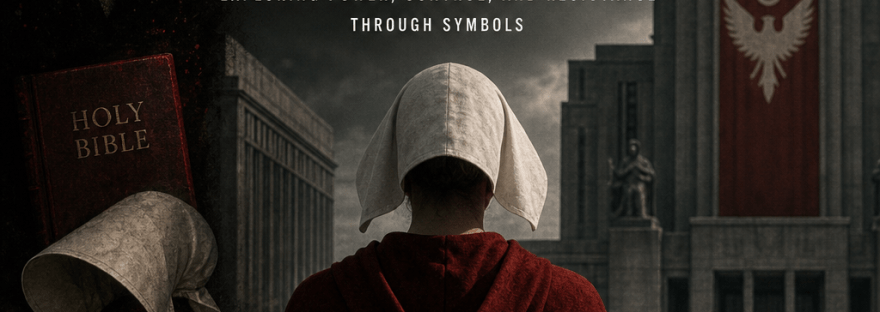
Handmaids are fertile women assigned to Commander households to become pregnant and produce children for the ruling class. Their bodies are treated as national resources.
Gilead justifies this by claiming a “state of emergency” due to plummeting birth rates.
The red clothing symbolizes blood and life – marking them as reproductive vessels, not human beings.
Free Will, the Body as a Temple, and Why Coercion Isn’t Christlike
Call me a feminist, but no man or woman has the right to dictate what someone does with their body.
In Christianity, our bodies are temples – but God is the judge, not the state.
As a man, I will never fully understand what women go through. But I can see that in the U.S. today, women are being told – and sometimes forced – to make choices about their bodies based on laws shaped by religious ideology.
There is nothing wrong with conservative values.
There is nothing wrong with choosing a lifestyle of discipline and faith.
But forcing those beliefs onto others is not Christlike.
Jesus never coerced anyone into following Him.
Where the U.S. Echoes Gilead – And Where It Doesn’t
No, the United States is not Gilead.
We do not have:
- forced reproductive servitude
- a caste system of women
- bans on literacy
- a theocratic dictatorship
- the elimination of elections
But we are seeing echoes:
- gender inequality
- religious influence on law
- democratic erosion
- surveillance
- political polarization
These patterns don’t make us Gilead – but they make people uneasy.
The Themes That Feel Uncomfortably Familiar Today
Across the world and here at home, we see:
- real-world rollbacks of women’s rights
- authoritarian patterns that mirror Gilead’s rise
- religious extremism influencing laws and culture
- global examples of Gilead-like oppression
- propaganda and censorship
- pandemic-era restrictions that made Gilead feel eerily familiar
Atwood once said:
“Nothing in the book hasn’t already happened.”
That’s why it feels so relevant.
Atwood’s Warning: “Nothing in the Book Hasn’t Already Happened”
Gilead is not fantasy – it’s a mirror.
It reflects:
- fears about losing rights
- anxieties about extremism
- the suffering happening to women globally
- how quickly “ordinary life” can collapse
Dystopias aren’t meant to predict the future.
They’re meant to warn us before it’s too late.
So What Do We Do? Staying Awake Before It’s Too Late
So what do we do?
We stay awake.
We pay attention.
We speak up.
Rights are rarely taken all at once.
They’re chipped away quietly, piece by piece, until one day we look up and realize we’ve lost more than we thought.
Today, we see:
- book bans
- Roe v. Wade overturned
- voting rights weakened
- political grifting
- silence from those in power
Who is speaking up for the people?
Who is fighting the good fight?
It feels like crickets.
But silence is how Gilead began.
And awareness is how it’s prevented.


