
I’m sharing this both as an update and as a reminder to fellow writers: your work can keep evolving, and better tools can help you get it closer to what you meant all along.
My writing journey continues every day.
I’m at a strange point right now: I’m writing regularly, publishing in different genres and frames of thought, and putting myself out there for the world to read.
At the same time, I understand the world isn’t necessarily reading my work—and that’s okay.
I write for the challenge, as a form of self-therapy.
What comes out of that process becomes a piece of work: a book, a novel, a blog post.
Still, the amount of time and energy I put into creating and sharing my work can leave me feeling spent.
Re-editing with better tools
Lately I’ve been feeling those tired moments.
I decided to go back and re-edit some of my previous work—this time with better technology than I had before.
Microsoft Copilot, for example, has been doing wonders for me as a writer.
It feels like having an editor at my fingertips, opening my eyes to my style, wording, and grammar.
To be clear: I am not letting AI write my books, and I never will.
I use it as a tool—to point out places I can improve, spot run-on sentences, and tighten up what I already wrote.
It isn’t perfect, and it has flaws, but so far it has helped me more than it has hurt.
A real example: The Menagerie Locket
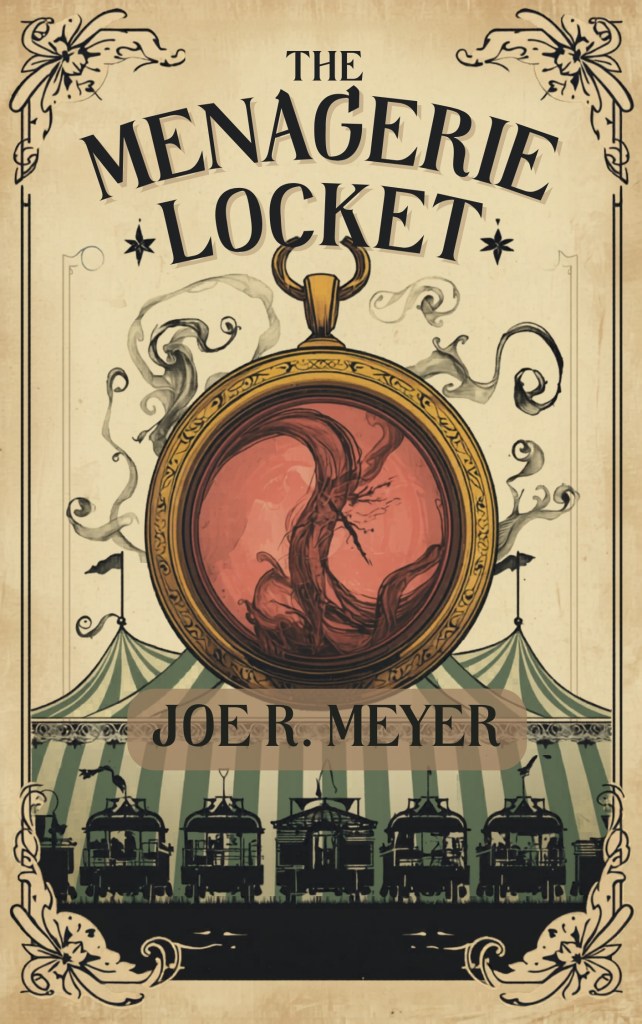
Case in point: my book The Menagerie Locket.
I owe my readers an apology, because in March I released a second edition with a new cover and some re-editing for clarity.
Then Copilot came along, and I started experimenting with additional recommendations.
I say recommendations because that’s what it gives me: suggested changes.
I can accept them or leave them. AI doesn’t overwrite what I’ve written—the choice is always mine.
It pointed out a better way to describe a scene, helped me trim run-on sentences, and caught some weak grammar. I’m grateful for that.
What ended up happening is that I created a “second edition of the second edition.”
I guess it could really be considered a third edition—along with an improved cover.
After seeing the power of AI design tools, I’ve experimented and found that the results can be far better than what I’m able to create on my own.
If it benefits my books and my readers, I’m going to keep using it—because why reinvent the wheel when I can create a cover that truly matches what I envision?
The truth: a book is never really “done”
Being a writer is stressful, simply because a book is never fully done.
There are always ways to make it better, clearer, or just different.
Leaving a book alone hasn’t been my strong suit, which is why I release new editions every few years—to refresh the material, revisit the characters I created, and give the story a little facelift.
Revisiting past characters can be painful too—seeing exactly what they struggled with—but I’m committed to making my work higher quality for myself and for my readers.
Next up, I plan to refresh POX again, as well as The Stricken.
And I’m also starting my next new piece of literature this week.
There will be more to come on that book soon, but I’m genuinely excited about what’s ahead.
Legacy (a morbid turn, but an honest one)
Here’s my morbid turn: there may come a time when I’m no longer here.
If that happens, my wife, daughter, and family will have control over my body of work.
I want them to be able to use it for good—or for whatever purpose they choose.
Heck, maybe they’ll make me into the next J.R.R. Tolkien or George Orwell. That’s my dream.
But the truth is, I may not be alive to see my books fully come into fruition—and there’s a strong possibility my work could be lost or forgotten, like so many authors.
There are so many of us in the world creating and publishing.
Still, my family will have a piece of my legacy that they can keep for a lifetime, and maybe even pass down through generations.
And maybe—one day—I’ll be noticed, the way some artists who were once overlooked are remembered later, like Van Gogh.
In the meantime, I’ll keep writing—being a person of deep thought—and putting my work out there for the world to read.
My strategy as a writer is simple: put out new work, refresh previous books for new audiences, and build a much larger library over the years.
If you’d like to support that journey, the best way is to read my books.
And if one of them resonates with you, share it with someone else who might enjoy it too.
The Menagerie Locket, POX, and The Stricken are all out there, and I’m proud of the stories they’ve become.
I’m grateful to every reader who supports my work with their hard-earned money.
I value you, and that’s exactly why I care so much about the quality of what I put out into the world.


I use Copilot often to ask questions & create images. Are you cutting and paste in Copilot your post for help? I have the free account and haven’t looked at other options. Thanks.
LikeLiked by 2 people
That’s great, you can use it to refine and structure your documents, meaning your voice is still in what you wrote, it can draft documents and make images from scratch. I use it to help refine my blogs like punctuation, sentences structure and for my books I can line edit and polish my manuscripts, still keeping my voice and style in my work.
LikeLiked by 2 people
That’s great. I don’t want AI rewriting my post, it’s not my words. I also keep in miss that AI is not factual, that helps when asking questions. It’s just a starting point for me to research for accurate information. Thanks.
LikeLiked by 2 people
Yes , different ways to approach using it. I don’t fully embrace AI because i don’t want to lose my words and voice in my writing and often when you say I use AI many may think I’m having it write my blogs and books but don’t just using like if I use grammar check to make sure my writing makes sense .
LikeLiked by 2 people