

A horror novel reborn — and the journey that changed everything
Joe R. Meyer | October 2026 |
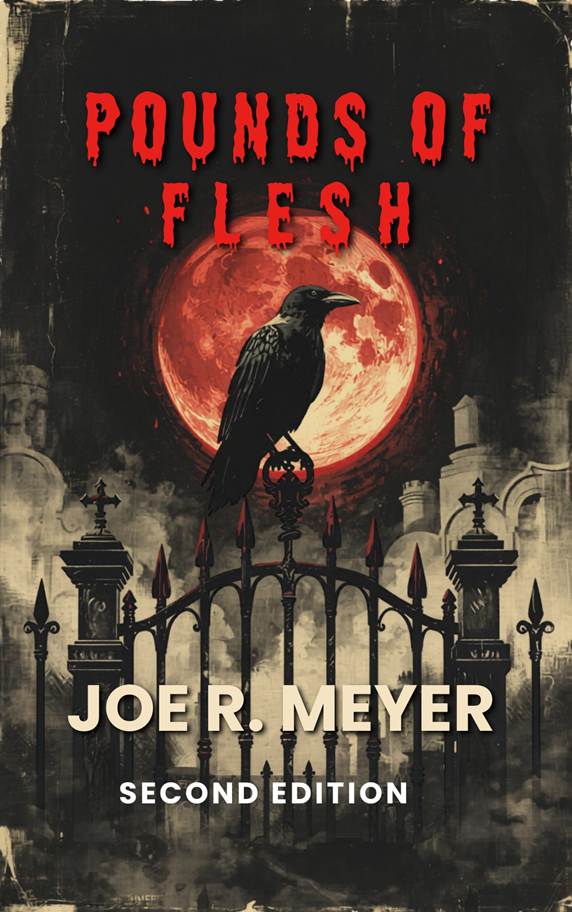
Pounds of Flesh — Second Edition cover. A horror novel by Joe R. Meyer.Blood. Available October 26th.
THE UPDATE — WHAT IS THE SECOND EDITION?
It’s here. The second edition of Pounds of Flesh is now available, and I want to take a moment — a real moment, not just a social media blurb — to tell you what this book is, what it became, and why I felt compelled to tear it apart and put it back together again. If you’re new to my work, welcome. If you’ve been waiting on this one, thank you for your patience. I think you’re going to find it was worth it.
Pounds of Flesh is a horror novel — but it is also, at its core, a western. It’s a supernatural story about a man named Jacoby who has done the worst thing a person can do: he made a deal with a demon. The demon’s name is XIC. The terms are brutal and specific. In exchange for seeing his family again, Jacoby must collect “pounds of flesh” from a list of victims — each body part a literal payment on his contract. The story begins with Jacoby crawling out of Hell through a cemetery in California, disoriented, guilty, and bound. He is guided through this strange new purgatory by two unlikely companions: a crow, and an old groundskeeper named Francisco Luis Gutierrez, who has been walking this earth for over 150 years under the same demon’s employ. The year is 1856. The American West is brutal and beautiful, and it has no mercy for a man with debts.
The tone of this book is something I’m proud of — and it took me two tries to get it right. It is intense. There are moments of real violence, real horror. But at its heart, Pounds of Flesh is a tender story. It asks a question I find genuinely difficult: can a man choose good when he has already sold himself to evil? Can he feel something — love, loyalty, guilt — when a demon has claimed his soul? I don’t think there are clean answers. I think that’s what makes it worth reading.
| “Get your pounds of flesh, but you may regret it.” |
That tagline found me partway through the rewrite, and it hasn’t left. It works on multiple levels — as a threat, as a warning, and as something almost like a prophecy for Jacoby himself. Because by the time you reach the final pages, you may find that the person who regrets it most is the one who thought he was in control all along.
THE REWRITE EXPLAINED — FROM FIRST DRAFT TO FINAL MANUSCRIPT
Let me be honest with you about something: the first version of this story was raw in a way that wasn’t always intentional. There was energy in it — breathless, urgent, stream-of-consciousness energy — but energy without shape is just noise. Long, unpunctuated sentences. Lowercase dialogue. A kind of controlled chaos that reflected my own relationship with the material at the time, which was: I was obsessed, I was writing fast, and I wasn’t stopping to ask whether any of it was landing. Writing that version of Pounds of Flesh felt like falling. The rewrite felt like learning to walk.
Voice and Prose. The most fundamental change in the second edition is in the sentence-level prose. The original draft had a breathless, immediate quality — there was something almost feverish about it, and I think that instinct was right for the material, even if the execution wasn’t. The rewrite kept the urgency but gave it a spine. Shorter paragraphs. Punchy, controlled sentences that hit harder precisely because they don’t overstay their welcome. Properly formatted dialogue that breathes and lands. And above all, a much stronger sense of time and place — the smell of California dirt in 1856, the weight of a saddle, the particular quality of silence in a graveyard at dusk. The darkness in the final manuscript is deliberate. It earns every shadow.
Chapter Titles and Structure. The original draft used generic chapter numbers. Chapter 1. Chapter 2. That’s fine for a draft — it gets you through — but it leaves the reader with nothing to hold. The final manuscript gives each chapter a title that does real work. “The Long Line” — that’s Jacoby’s arrival in Hell, the interminable dead queue, the weight of waiting when you already know you’ve lost. “Blood Oath” — his encounter with XIC, the moment the contract becomes real. “Destined” and “Spoken For” — his time on the Jacobson Ranch, where something unexpected starts to grow in a man who thought he had nothing left to feel. These titles add a literary layer the original completely lacked. They signal to the reader that this is a story that knows what it’s doing.
| “The foreword is an invitation. It says: I know this is dark. I know Jacoby doesn’t always deserve your sympathy. But come in anyway.” — Joe R. Meyer, from the author’s foreword to the Second Edition |
The Foreword. The final version opens with something the original draft never had: a personal foreword from me to the reader. I want to be clear that writing it was not easy. It required me to acknowledge my own relationship with regret and with bargains — not supernatural ones, but the everyday kind. The deals we make with ourselves. The promises we let slide. The foreword sets the emotional context of the novel before a single chapter begins. It invites the reader into Jacoby’s world by first acknowledging that we all know, in some smaller way, what it feels like to have traded something we shouldn’t have. It also includes a content warning, delivered with care — because this book has real darkness in it, and I believe readers deserve to know what they’re walking into.
World-Building Details. The original draft had vivid ideas — I was never short on those — but the texture was underdeveloped. The rewrite fixed that. Francisco Luis Gutierrez’s role as a “grave warden” was expanded substantially; he went from a colorful supporting figure to a genuine anchor of the story’s mythology. The cemetery as the literal threshold between time periods was made far more explicit — the sense that this is a place where the rules don’t apply, where 1856 and the present collapse into each other like two pages pressed together. And the Old West setting was enriched with sensory detail throughout: the sun-fried skin of men who work outside, the smell of horses and woodsmoke, the particular silence of a frontier town at midday. The world became real enough that the horror could actually land in it.
The Emotional Core. The original Jacoby was reactive. Things happened to him. He moved through the story like a man in shock — which, to be fair, he is — but there was no interiority, no inner weather. The rewrite gave him a genuine emotional life. His feelings for Nadia Jacobson, which emerge slowly and almost against his will. His guilt over his dead family, which sits behind every scene like a low note you can feel in your chest. His profound confusion at discovering that the demon who torments him has, somehow, given him back a conscience — as if XIC wants Jacoby to feel every ounce of what he’s doing. That contradiction is the engine of the book. By the time you reach the final chapters, you root for Jacoby. You know he doesn’t always deserve it. You root for him anyway.
| Interior preview: “The Long Line — Hell (Undated)” Clean serif layout with chapter ornament. | Interior preview: “Blood Oath — Hollydale Local Cemetery, California — 1856.” Literary horror typography. |
THE COVER — EVOLUTION OF A VISUAL IDENTITY
When I look at the final cover for the second edition, I think: yes. That’s the book. That’s exactly what this story feels like from the inside. The design is stark — black and white, clean lines — with explosive blood-red splatter that drips from above and pools at the bottom of the frame. It shouldn’t work as elegantly as it does. Chaos and cleanliness aren’t natural partners. But the tension between them is exactly the tension at the heart of Pounds of Flesh: a man who is simultaneously filthy with sin and reaching, desperately, for something clean. The title treatment is massive and commanding — “POUNDS” in black, “OF FLESH” in that deep arterial red — filling most of the cover in a distressed, horror-western typeface that feels worn-in and dangerous. At the lower right, a crow silhouette perches in shadow. If you know the book, you know exactly who that is. If you don’t yet — you will.
The tagline sits mid-cover, right where it belongs: Get your pounds of flesh, but you may regret it. And my name anchors the bottom in a bold western-style face that holds the whole composition together. I want to acknowledge that the first edition cover was good — it did its job — but it didn’t capture the tonal shift that the rewrite achieved. The second edition cover is rawer, more visceral, and more deliberate. Like the prose itself. They evolved together, and I think you can see it.
The interior received the same care. The chapter pages feature a clean serif layout with ornamental chapter-number treatments and drop-cap-style openers that give the book a genuine literary horror feel — the kind you find on your shelf next to writers who take the genre seriously. Chapter headings like “The Long Line — Hell (Undated)” and “Blood Oath — Hollydale Local Cemetery, California — 1856” are set with weight and intentionality. Every element of the book’s physical presentation is designed to say: this story deserves your full attention. I hope it gets it.
A NOTE TO READERS — FINAL AUTHOR MESSAGE
Thank you — genuinely, sincerely — for picking this up. A story this personal asks something of a writer that most people don’t see: the willingness to be wrong about it, to take it apart, and to try again. Pounds of Flesh began as a private obsession. A man at a cemetery gate, carrying something heavy, not entirely sure what century he’d crawled into. It stayed private for longer than it probably should have. The rewrite gave it the space it needed to become something larger, something that I hope reaches past my own head and into yours. If you enjoy dark westerns, supernatural horror, or stories about deeply flawed people reaching toward something they’re not sure they’ve earned — this book was written for you specifically, and I mean that with my whole chest.
Parts of this story are intense. There is violence. There is horror. I don’t apologize for either, because both serve the character and the consequence — which is the only reason darkness belongs in fiction. But I also want you to know that the book has warmth in it. Unexpected warmth, the kind that feels more powerful precisely because of what surrounds it. The foreword will prepare you. Gutierrez will make you smile, even at the worst moments. And Jacoby — complicated, guilty, improbable Jacoby — may surprise you. If somewhere along the way you find yourself rooting for a man who doesn’t always deserve it, you won’t be alone.
| “If somewhere along the way you find yourself rooting for a man who doesn’t always deserve it — you won’t be alone.” |
Pounds of Flesh — Second Edition is available October 26th at all major online retailers.


