One Man’s Truth About Division, Inequality, Media, and Faith in a Fractured Nation
The America I Was Promised
I grew up believing in America the way you believe in something you’ve never had to question — with a full, uncomplicated heart. The version I was handed went something like this: if you work hard, if you are honest, if you keep your head down and push through, this country will meet you somewhere in the middle. Freedom wasn’t just a word on a monument. It was a promise. And like a lot of Americans, I held onto that promise with both hands.
But promises have a way of revealing their fine print. The older I get, the more I’ve had to sit with the uncomfortable distance between the America I was taught to love and the America I actually live in. This essay isn’t an act of cynicism. It isn’t written in anger, though I’ve felt anger. It’s written in honesty — which I believe is the most patriotic thing I can offer right now. Because I still love this country. I love it enough to tell the truth about it.
What I want to do here is speak plainly about what I see: the fractures, the inequalities, the noise, and — yes — the grace. I want to talk about what faith has given me that politics never could, and I want to share a piece of my own American story, the good and the hard and the real. This is not a manifesto. It is a reckoning — mine, offered in the hope that it might resonate with yours.
Section 1 — The Fracture: Political Division That Feels Personal
On tribalism, echo chambers, and the quiet cost of independent thought.
Somewhere along the way, political disagreement in America stopped feeling like a debate and started feeling like a declaration of war. It used to be that two people could sit across a table, hold opposing views about tax policy or immigration, and still pass the bread. That table still exists in some places, but it gets harder to find. What I see more often now are people who have sorted themselves — by neighborhood, by news feed, by the company they keep — into camps so insular that the other side has ceased to feel like fellow Americans at all. They have become the enemy.
I’ve felt the pull of that sorting. I’d be lying if I said I hadn’t. There are moments when the outrage of one side or the smugness of another makes it tempting to just pick a lane and drive fast. It’s exhausting to hold complexity. It takes work to say “I agree with this part, but not that part,” when the world around you is demanding full allegiance. But I’ve come to believe that surrendering independent thought is one of the most dangerous things an ordinary person can do — not for political reasons, but for deeply personal ones. When you let a party or a pundit do your thinking for you, you give away something that is yours and yours alone.
| The people who benefit most from our division are rarely the ones suffering from it. Division is a strategy, not an accident. |
The hardest thing about the fracture isn’t the headlines. It’s the relationships. It’s the family member you now tiptoe around at Thanksgiving. It’s the old friendship that quietly dissolved over social media posts neither of you even wrote. It’s the community that should be united by shared geography and shared struggle, divided instead by tribal loyalties to people and institutions that don’t know their names. I don’t have a clean answer to this. But I do know that the fracture hurts ordinary people the most, and serves the powerful the best.
Section 2 — The Lie of the Level Playing Field: Inequality in America
On meritocracy, ZIP codes, and what it actually costs to work hard.
America loves the story of the self-made person. Pull yourself up. Work hard. Earn your place. It is a beautiful story. It is also, for far too many people, a story that was rigged before the first chapter was written. I’ve watched people work with everything they had — two jobs, no days off, genuine sacrifice — and still not make it to something that could be called security. Not because they lacked effort, but because effort alone was never the only variable.
The playing field in this country is not level, and I think most people — if they are honest — know this. The advantages you are born with: the ZIP code you grow up in, the school that shapes your early mind, the networks your family has access to, the color of your skin, the accent in your voice — these things shape outcomes in ways that hard work alone cannot fully overcome. This isn’t a political talking point. It’s what I’ve seen with my own eyes, in my own community, in the lives of people I respect and love.
What bothers me most isn’t the inequality itself — though it is real and it is painful. What bothers me is the mythology that turns inequality into a moral verdict. When someone fails to climb out of a difficult situation, the easy narrative is that they didn’t want it badly enough. That narrative is a lie, and it is a particularly cruel one because it redirects the weight of systemic failure onto the backs of the individuals it is failing. The meritocracy myth doesn’t just ignore inequality. It justifies it.
| Personal Reflection I’ve worked hard my whole life. I believe in the dignity of that work. But I’ve also had to reckon with the ways the system makes some people’s hard work worth more than others’. That reckoning didn’t weaken my work ethic. It deepened my empathy. |
Section 3 — Who Controls the Narrative: Media and the Manipulation of Truth
On spin, algorithms, and becoming a more skeptical consumer of information.
I used to trust the news. Not blindly, but with a reasonable default assumption that what I was hearing was, more or less, the truth. That assumption has had to be completely rebuilt. Not because the truth doesn’t exist — it does — but because finding it now requires a level of active, critical effort that most people simply don’t have time for. And the people who design these information systems know that.
Corporate media has financial interests. Social media platforms have algorithmic ones. Partisan outlets — on every side of the spectrum — have ideological ones. The result is that the average American is not receiving information so much as they are receiving carefully curated reality tunnels, designed to confirm what they already believe, stoke the emotions that keep them engaged, and quietly erode their trust in anything that exists outside their chosen feed. I’ve been inside those tunnels. Most of us have.
My own turning point came gradually. I started noticing how two outlets covering the same event told completely different stories — not just with different spin, but with different facts foregrounded and different facts buried. I started asking: who owns this outlet? What are they selling? Whose interests does this narrative serve? These are not paranoid questions. They are the basic questions of a free citizen. Media control has always been a tool of power. The difference now is the scale, the speed, and the sophistication of the manipulation.
I’m not saying trust nothing. I’m saying trust slowly, verify often, and never let any single source — however much it tells you what you want to hear — be the only voice in your ear. The truth is still out there. But you have to go looking for it.
Section 4 — What Faith Gives Me That Politics Cannot
On anchors, grace, and the peace that passes understanding.
I want to be careful here, because I am not trying to preach. Faith is personal, and what works for one person may not work for another. But this essay wouldn’t be honest if I left this part out, because it is the truest part of my story. Faith is the thing that holds me together when the rest of it feels like it’s coming apart.
Politics — for all its importance, for all the real stakes involved — cannot do what faith does. Politics gives you a side. Faith gives you a foundation. Politics tells you who the enemy is. Faith asks you to love them anyway. I have found that no ideology, no party, no cable news personality has ever given me genuine peace. But prayer has. Scripture has. The quiet, stubborn belief that this life is not the whole story — that something greater than any human system is at work — that has.
| When I feel like the system is rigged and the odds are stacked and the noise is too loud to think, I don’t reach for a political solution first. I reach for God first. |
That doesn’t make me passive. My faith, in fact, is the source of my drive to engage — to care about justice, to speak honestly, to serve my community, to refuse cynicism when it would be so much easier. The call to love your neighbor doesn’t stop at the boundaries of agreement. It extends into the uncomfortable, the inconvenient, and the ideologically contrary. That is harder than any political stance I’ve ever taken. And it is more sustaining.
What faith gives me is not the promise that everything will work out neatly. It is the strength to show up anyway when it doesn’t. That is what I lean on. That is my anchor in a fractured nation.
Section 5 — My Experience as an American: The Good, The Hard, The Real
A candid look at one life, lived within these larger forces.
I am not writing from a position of perfect safety or settled comfort. My American story has been complicated — which, I think, makes it pretty American. There have been times I’ve worked myself down to the bone and wondered what it was for. Times the system felt less like a ladder and more like a wall. Times I looked at the life I was supposed to have by now and felt the gap between that and the life I was actually living.
But here’s what’s also true: I have known kindness from strangers. I have seen communities pull together in ways that no politician can take credit for. I have received help I didn’t ask for and couldn’t have predicted, from people who had no reason to give it beyond basic human decency. I’ve sat at tables I was told weren’t for me and found, when I got there, that the seat was always open. Those moments matter. They are real, and they are part of the story too.
I live in a place I love — San Dimas, California — a community that has its own complexity, its own mix of struggle and beauty. And I have come to believe that the truest picture of America is not found in Washington, D.C. or on prime-time television. It is found here, in the ordinary lives of ordinary people trying to do right by their families, their neighbors, and themselves. That is the America I still believe in. Not the mythology. The actual, imperfect, resilient people.
My story isn’t finished. Neither is this country’s. Both of us are still in the middle of something. I’ve learned to be okay with that.
Conclusion — Still Believing, Still Fighting
I do not believe in blind patriotism. Wrapping yourself in a flag while refusing to look honestly at what the flag represents — the full history, the full reality — is not love. It is avoidance. Real love for a country, like real love for a person, requires the willingness to see clearly and stay anyway. To say: this is broken, and I am not leaving.
America is worth fighting for. Not because it is perfect — it is profoundly, sometimes heartbreakingly imperfect. But because the idea at its core, however incompletely realized, is genuinely worth protecting: that human beings have dignity, that freedom matters, that the arc of history can bend toward something better if enough people refuse to let it bend away. I believe that. On good days and hard days alike, I believe that.
What I’m asking — of myself, and of anyone reading this — is not agreement. I’m asking for engagement. Stay in the conversation, even when it costs you something. Think critically about what you’re being told and by whom. Act with compassion even when the political moment says to harden. Build the table wider, not smaller. And when the noise gets too loud and the fracture feels too deep, find your anchor — whatever it is — and hold on.
This country has survived things that seemed unsurvivable. So have a lot of the people in it. That resilience is real, and it lives in ordinary people, not in institutions. I count on it. I count on you. I’m still here, still believing, still fighting — and I hope you are too.
— Joseph writes from San Dimas, CA, where he is still figuring it out, one day at a time. If this piece moved you, challenged you, or made you think, he’d love to hear from you in the comments below. Share it with someone who needs it. The conversation matters.
Published on The Joseph Files | © 2026 Joseph | All Rights Reserved
San Dimas, CA • Tuesday, June 16, 2026 • opinions expressed are solely those of the author
For those who would be interested September my new book comes out Silent Nation.
examines how power no longer relies primarily on force, but on fear, exhaustion, distraction, and compliance. Workers remain trapped by economic precarity. Citizens are overwhelmed by information yet disconnected from agency. Media and technology shape perception while discouraging sustained accountability. Silence is not accidental—it is produced, rewarded, and enforced.
Blending social critique, political analysis, and lived experience, this book challenges the idea that neutrality is harmless or that disengagement is apolitical. It confronts the belief that survival requires silence and reveals how modern systems function most efficiently when resistance feels risky and resignation feels normal.
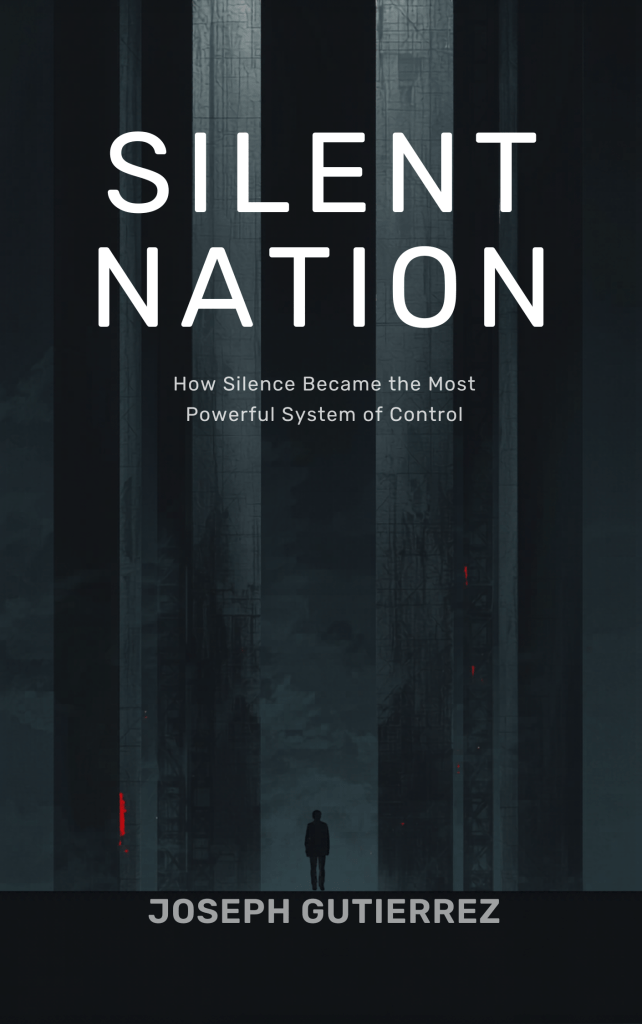
This is not a partisan manifesto or a call for outrage. It is a diagnosis—clear, direct, and intentionally uncomfortable. Silent Nation invites readers to recognize how power operates through normalization, how silence stabilizes inequality, and how systemic harm becomes routine.
For readers interested in social justice, economic inequality, political power, labor issues, mental health, media influence, and the future of democracy, Silent Nation delivers a sobering insight: the most effective form of control today is not repression, but acceptance.
Breaking the silence is the first step toward reclaiming agency, responsibility, and collective accountability.


